BREAKING NEWS

BREAKING NEWS ""**Expected DA for Bank Employees from Aug 2024 MINIMUM 7 SLAB AND MAXIMUM 24 SLAB*****I *****

VISITOR FROM WORLD

Free counters!

YOU ARE VISITOR

Blog Archive

LIVE

BREAKING NEWS ""**If we want PSU bank to compete with Pvt bank ---Give them a break Saturday first****Outcome of Today’s meeting with IBA - 31.01.2023*********

Thursday, September 25, 2025

Government Bank Employee Resigns citing Health Issues and Toxic Work Culture

 After Vaani, a 29-year-old woman who quit her government bank job, another government bank employee has now resigned, raising serious allegations of a toxic work culture prevailing in public sector banks

A government bank employee, who had been working for 15 years, has decided to quit his job. He said that his decision was not sudden, but the result of health problems, growing work pressure, and the loss of personal peace of mind

He shared his story on the popular Reddit community r/IndianWorkplace, where many professionals discuss their work-life experiences. His post quickly caught attention because it challenged the common belief that a government banking job is always “safe and prestigious”.

Feeling Trapped in a ‘Dream Job’

In his post, the 39-year-old employee wrote, “At 39, I feel suffocated in my government bank job. I don’t think I can do it anymore.” He also uploaded a picture of his office to show the reality of his workplace.

The photo seems to be of Indian Bank. This means that the person was working in branch of Indian Bank – one of the public sector banks in India.

The banker recalled how he once saw the job as a dream come true. He had cleared three rounds of tough, all-India level exams to secure this position. Like many others, he believed a Public Sector Undertaking (PSU) bank job would bring him stability, a good salary, a house, a car, and respect in society.

But over the years, things changed. The dream of stability turned into a life of stress and poor health.

Health Issues and Long Work Hours

The employee revealed that his work life had taken a serious toll on his health. He is now suffering from high blood pressure, thyroid problems, and fatty liver disease. According to him, this happened because of:

  • Transfers to far-off and remote places
  • Strict sales targets that were almost impossible to meet
  • Extremely long working hours, often stretching from 10 am to 10 pm
  • Weekend work with no real time to rest (Work on Sundays)

Adding to his frustration, he said he was being forced to sell what he described as “useless insurance products” to customers. He felt this went against the true purpose of banking.

No Space to Raise Concerns

The banker also pointed out that employees were discouraged from raising their voices or sharing problems publicly, even on social media. He wrote that many of his colleagues were also reaching their breaking point, but were afraid to speak out.

In his own words: “I no longer feel like I can do justice to myself.”

A Bold Decision to Quit

Finally, he took the drastic step of simply stopping work. He admitted that he is still technically in service, but he has chosen not to report to duty anymore.

He concluded his Reddit post by writing: “Yes, this means my salary will stop. My financial struggles may begin. But I hope, with all my heart, that I’ll get my life back.

Tuesday, September 23, 2025

Breaking News! Bank Manager shot dead in Vaishali Patna Bihar

Patna, Bihar: A shocking incident took place in Vaishali district on Monday evening, where three bike-borne assailants shot dead a bank manager on the Chechar–Khanpur Pakri main road under Bidupur police station limits.

The victim has been identified as Rakesh Kumar (30), branch manager of Axis Bank, Kanchanpur. According to police, Rakesh was returning alone on his motorcycle after attending a meeting with a women’s group at Khapura in Bidupur regarding a loan when the criminals intercepted him and opened fire.

onfirming the incident, Sadar SDPO Subodh Kumar said that the body has been sent for post-mortem. A forensic team visited the spot and collected evidence, while police have begun a detailed investigation.

Monday, September 15, 2025

Recomended Merger of Bank in comming future

out of 12 Public sector banks in India, combination of banks most suitable to merger into 3 big banks from 12 now

The most suitable combination to merge the 12 public sector banks in India into 3 big banks would group them based on size, reach, and compatibility, maximizing their combined branch networks and financial strengths[1][2]. Below is a recommended merger structure based on market capitalisation, branch network, and government reform trends[3][4][5]:

### Recommended Merger Groups

#### Group 1: SBI-led Mega Bank
- State Bank of India (SBI)
- Bank of Maharashtra
- Central Bank of India
- UCO Bank

This group combines SBI’s existing dominance with banks that have a significant presence but are not among the top five by market cap. SBI, already the largest, can absorb these banks, yielding a strong pan-India reach with the highest total assets and branches[1][4][5].

#### Group 2: PNB + BoB Led North-Western Bloc
- Punjab National Bank (PNB)
- Bank of Baroda (BoB)
- Punjab & Sind Bank
- Indian Overseas Bank

This combination leverages PNB and BoB, the next biggest after SBI, and brings together banks with strong north-west and southern regional franchises, making the merged entity robust in both financials and geography[1][5].

#### Group 3: Canara + Union + Indian + Bank of India South-East Bloc
- Canara Bank
- Union Bank of India
- Indian Bank
- Bank of India

These banks, already large in market cap and branch network, would create a well-aligned entity strong in south and east India with potential to scale digitally and expand their footprint nationwide[1][5].

### Rationale for These Groups
- Maximizes operational synergy by combining banks with complementing geographical strengths.
- Ensures only strong banks combine with banks having weaker financials, minimizing risk concentration[4].
- Follows government aim for ‘banks of scale’ to increase global competitiveness and reduce fragmented management costs[6][7].
- Offers diversity in customer base, branch network, and product portfolio, essential for creating large, resilient banks.

### List of Current PSU Banks (2025)

| Bank Name                | Market Cap (₹ Cr) | Branches       |
|--------------------------|------------------|----------------------|
| State Bank of India (SBI)| 6,67,695         | 22,740 [1]       |
| Punjab National Bank     | 1,14,608         | 10,168 [1]       |
| Bank of Baroda           | 1,13,620         | 8,356 [1]        |
| Union Bank of India      | 91,122           | 8,572 [1]        |
| Canara Bank              | 86,044           | 9,816 [1]        |
| Indian Bank              | 73,800           | 5,877 [1]        |
| UCO Bank                 | 50,753           | 3,263 [1]        |
| Bank of India            | 49,000           | 5,202 [1]        |
| Central Bank of India    | 44,351           | 4,541 [1]        |
| Bank of Maharashtra      | 39,242           | 2,551 [1]        |
| Indian Overseas Bank     | ---              | --- [1][5]  |
| Punjab & Sind Bank       | ---              | --- [1][5]  |

This strategic combination would help create three globally competitive Indian public sector banks capable of driving economic growth and supporting the next wave of banking reforms[5][7].

Citations:
[1] List of Government Banks in India 2025 https://www.mymudra.com/blog/list-of-government-banks-in-india-2025
[2] List of Government Banks in India​ 2025 https://lakshmishree.com/blog/government-banks-in-india/
[3] Bank Merger List in India 2025, Complete List https://www.oliveboard.in/blog/bank-merger-list/
[4] Latest List of Merger of Banks in India https://groww.in/p/savings-schemes/banking-mergers-in-india
[5] Government Banks in India 2025 PDF: Top 10, Public ... https://guidely.in/blog/government-banks-in-india

GOVT PLAN TO MERGE BANK AND MAKE TWO MEGA BANK


Sunday, September 14, 2025

Bank holidays this month , September 18-30, 2025

List of bank holidays in September

  • September 18 (Thursday) –All private and public banks will be closed in Jammu and Srinagar in observance of the Unitarian Anniversary Day which is kept in honor of the founding of the Unitarian Church in 1887.
  • September 21  Sunday
  • September 22 (Monday) – All banks will be shut in Jaipur as the city will celebrate Navratra Sthapna, marking the beginning of Navratri celebrations among Hindus.
  • September 23 (Tuesday) – All public and private banks across will remain shut in Jammu and Srinagar in celebrations of the birthday of Maharaja Hari Singh Ji, the last ruling monarch of Jammu & Kashmir.
  • September 27 -4th Saturday All india bank holiday
  • September 28  Sunday
  • September 29 (Monday) – It is a RBI mandated bank holiday for Agartala, Kolkata and Guwahati in observance of Maha Saptami, which is the seventh day of the Durga Puja festival, celebrated in the Hindu month of Ashwin.
  • September 30 (Tuesday) – Multiple cities, including Agartala, Bhubaneswar, Guwahati, Imphal, Jaipur, Kolkata, Patna and Ranchi will observe banks closure due to Maha Ashtami/Durga Ashtami, the eighth day of the Hindu festival of Durga Puja and Navratri.

What transactions can you do when banks are closed?

A person can continue to use online or mobile banking services even during national holidays — unless notified to users for technical or other reasons. For cash emergencies, ATMs are open for withdrawals as usual. People can also use their respective bank’s app and UPI to facilitate payments.

Tripura: Rs.16 Crore Fraud Exposed in Agartala Municipal Corporation’s UCO Bank Account

Police have arrested a cashier from UCO Bank branch. She has been identified as Ramayani Shrimayi, a resident of Nowgaon district in Assam. Police, however, have not provided details of her alleged connection with the scam. As per sources, she provided technical support to the scamsters

The UCO Bank has already paid back the embezzled fund to the AMC account as demanded by Mayor Dipak Majumder. Bank officials said they are cooperating with the police to track down the scammers and prevent such occurrences in the future.


Agartala: A big scam of Rs.16 crore has been reported in the account of Agartala Municipal Corporation (AMC) account at UCO Bank. Tripura Police have started a major investigation into a massive financial scam of over ₹16 crore siphoned from the Agartala Municipal Corporation (AMC) account at UCO Bank. The fraud came to light on Thursday, but no arrests were made within the first 24 hours. Initial findings suggest possible involvement of bank employees.

How the Fraud Happened?

Between August 5 and September 2, fraudsters managed to withdraw funds from AMC’s account by using cloned cheques. These cheques carried genuine AMC cheque numbers but were never actually issued by the corporation.

The fraud was carried out through RTGS transactions, totaling ₹16,38,43,300, according to the FIR filed by UCO Bank’s Zonal Head, Sanjib Roy, at West Agartala Police Station. At least six forged cheques were used, each with authentic-looking signatures of AMC’s CEO, raising serious concerns about how fraudsters accessed specimen signatures. An unidentified man, posing as an AMC representative, visited the UCO Bank branch multiple times to submit these forged cheques. CCTV footage captured his movements

AMC officials confirmed that the cheque numbers used in these transactions remain intact in their own records. This confirms that the cheques were cloned copies, not originals. UCO Bank managed to freeze one account, but nearly ₹14 crore had already been diverted into multiple company accounts. Investigators believe that the masterminds behind the fraud are operating from outside Tripura.

AMC had already informed UCO Bank earlier that no RTGS transactions were authorized on the given dates, yet the fraudulent transfers still went through.

Investigation Underway

Police officials said that the investigation is progressing and several suspects have been questioned. They suspect insider involvement at both AMC and UCO Bank.

Bankers Must Stay Extra Vigilant with Government Accounts

Government accounts hold large sums of public money, making them prime targets for fraudsters. Recent scams show how cleverly criminals use forged documents, cloned cheques, and impersonation to siphon off funds. Bankers need to exercise extreme caution while dealing with such accounts

  • Verify Every Transaction: Large withdrawals or RTGS transfers from government accounts should be thoroughly cross-checked with the concerned department before approval.
  • Check Signatures Carefully: Fraudsters often use cloned cheques with genuine cheque numbers. Always compare signatures with specimen records and escalate even the slightest mismatch.
  • Strengthen KYC & Monitoring: Ensure that accounts receiving government funds are genuine. Monitor unusual transactions, especially when sudden large credits appear in accounts with little prior activity.
  • Use Dual Confirmation: For high-value transactions, adopt a system of dual verification — both from the government department and senior bank officials.
  • Be Alert to Impersonators: Fraudsters may pose as government representatives. Always demand official authorization letters and verify them through independent channels.
  • Escalate Suspicious Activity Quickly: Any irregularity, delay, or unusual request should be immediately reported to higher authorities and the bank’s fraud monitoring cell.

Wednesday, September 10, 2025

Over Rs 15 Crore Spent on PM Modi’s 2 Day Visit to Jeddah, RTI Reply Reveals

 An RTI reply from the Consulate General of India in Jeddah has revealed that the Government of India spent ₹15.54 crore on Prime Minister Narendra Modi’s official visit to Jeddah, Saudi Arabia, held on 22–23 April 2025. The RTI sought details of expenditure on hotel bookings and transport arrangements for the Prime Minister’s delegation.

Key Expenditure Details as per RTI

The RTI reply mentioned that following expenditures were made during the visit of PM Modi to Jeddah.

  • Hotel Rental Charges: ₹10.26 crore
  • Transport Arrangements: ₹4.05 crore
  • Community Reception: Nil

The hotel expenses alone accounted for two-thirds of the total cost, making it the single largest component. Transport arrangements, which covered vehicle hiring and logistics, added another significant portion to the bill.

But Why so much high cost?

You must be thinking why so high costs are involved in visit of PM Modi to foreign countries. This usually happens because: Whenever a Prime Minister or President travels abroad, entire floors or even whole hotels are often booked to ensure top-level security. The delegation includes not just the Prime Minister but also ministers, senior officials, diplomats, security personnel (SPG, IB, local police coordination), media teams, and support staff. Luxury 5-star hotels are usually chosen because of their high security standards and facilities. In Saudi Arabia, such hotels are extremely expensive, especially when booked at short notice or in bulk.

A fleet of vehicles, including bulletproof cars, SUVs, and buses for the delegation, is required. Local transportation costs also include special security convoys, police escorts, and sometimes even temporary arrangements for armored vehicles. Fuel, drivers, and 24/7 availability during the visit add to expenses.

A Prime Minister’s foreign trip is treated as a VVIP event, requiring massive coordination with the host country. Hotels and vehicles are put under strict security checks, and sometimes even modifications are made (such as installing bulletproof glass, jammers, or secure communication systems). These special requirements significantly increase costs.

India must maintain certain diplomatic protocols. The PM of India is treated on par with world leaders like the US President or UK PM. This means expenses cannot be cut too low, as it would be seen as compromising on protocol or security.


Man shoots himself inside HDFC Bank in Mohali

In a shocking incident, a 45-year-old immigration consultant allegedly shot himself inside the toilet of an HDFC Bank branch in Mohali’s Sector 68 on Tuesday afternoon.

The victim, Rajdeep Singh, originally from Moga, was living with his family in Sector 80, Mohali. He also ran an office in Sector 82. According to eyewitnesses, Singh entered the bank around 2 pm, went directly to the toilet, and shot himself with a pistol

The sudden gunshot created panic inside the branch. Bank officials immediately alerted the police, who reached the spot and restricted entry to the premises.

Police Investigation

Police have recovered the pistol used in the incident. Investigators are checking whether it was a licensed weapon. No note has been found at the scene so far. Bank CCTV cameras are being examined to piece together the sequence of events. Bank employees present during the incident are being questioned. Police are also investigating whether Singh had an account or an ongoing loan with the branch.

Phase 8 SHO Satnam Singh said, “We received information about the incident around 2.30 pm, following which police teams reached the spot immediately. The forensic team has started their examination of the area. Bank officials are being interrogated to determine what exactly happened inside the branch. We are also investigating whether the gun used was a licensed firearm or not. The man reportedly shot himself in the toilet.”

DSP Harsimran Bal said, “Probe is at a very initial stage to comment. We are verifying the details. After the investigation, we will get to know the matter in depth, including why the man was stressed and what led to this action.”

Friday, September 5, 2025

Rs.75 Lakh missing from SBI Currency Chest in Shimla

A big case of financial misconduct has been reported in SBI Currency Chest in Shimla.

Rs 75 lakh has going missing from the currency chest of the State Bank of India (SBI), Kotkhai branch in Shimla, Himachal Pradesh.

According to the bank, the then Service Manager, Ashutosh Kumar Chandravanshi, is responsible such huge fraud. Along with him, current Service Manager Subhash Pal and Cash Officer Deepak Kumar have also been accused because they failed to fulfill their custodial duties.

The issue came to light on 6th August 2025, when bank officials carried out their regular bi-monthly verification of cash in the currency chest. During this checking, they discovered that 15 bundles of ₹500 notes, amounting to Rs 75 lakh, were missing. This shocked both the bank management and the investigating authorities.

After this, the bank conducted a detailed check of its records and registers but found no mistakes or mismatches in the system. Bank officials got suspicious that the money had been deliberately misappropriated.


On 7th August, a verification team from the Regional Business Office (RBO) was sent to the branch for further investigation. Senior officials, including Chief Managers of Operations and (D&VAS), examined the matter in detail. Even in this investigation, no system or dispatch error was found. This confirmed that the case was not due to clerical mistakes but likely due to fraud.

SBI filed complaint with the State Vigilance and Anti-Corruption Bureau. The matter is now being investigated by the Special Investigation Unit (SIU).

An FIR was filed by SBI RBO-7 Shimla’s Regional Manager, Ved Prakash, naming Ashutosh Kumar Chandravanshi, Subhash Pal, and Deepak Kumar as accused of fraud and criminal misconduct.

The Vigilance Bureau has booked the accused under several sections of the Indian Penal Code (IPC)—314, 316 (2), 318 (4), 344, and 61 (2)—as well as Section 13 (1)(A) read with Section 13 (2) of the Prevention of Corruption (Amendment) Act, 2018.

The investigation is ongoing and more details will be released soon.

Bankers at Risk: Cardiac Arrest Crisis Rising among Bankers


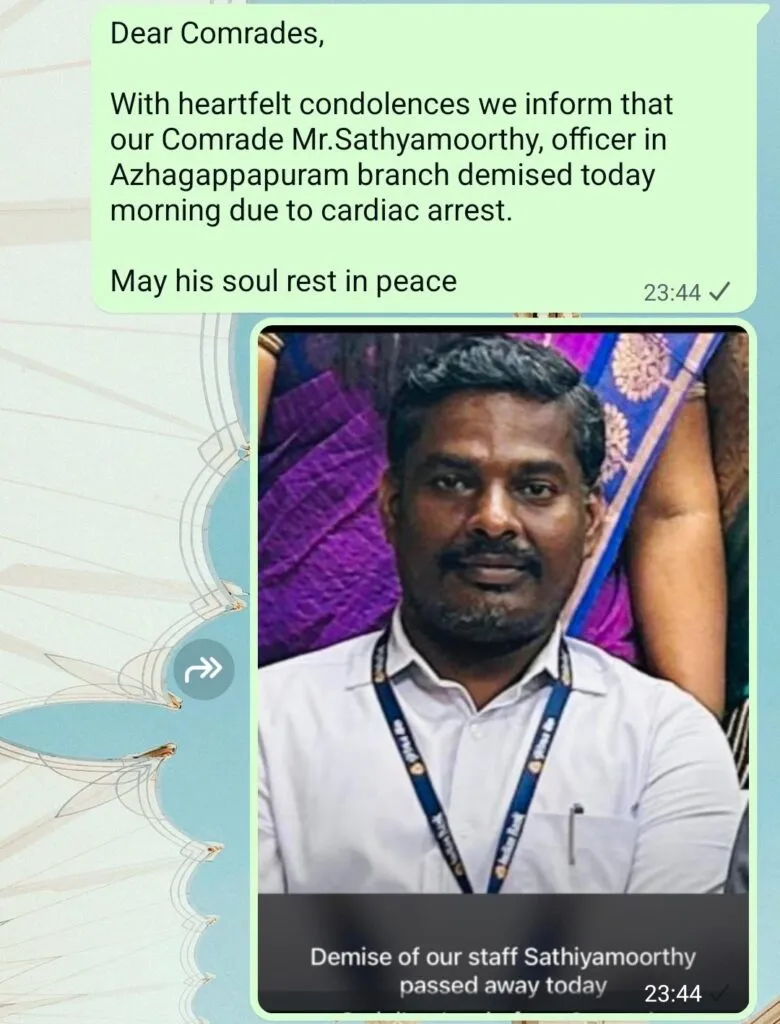
The banking profession, once seen as a secure and prestigious career, is now silently witnessing a worrying trend — an alarming rise in cardiac arrests among bankers. Long working hours, constant work pressure, irregular lifestyle, and lack of physical activity are pushing many employees in the sector towards life-threatening health conditions.

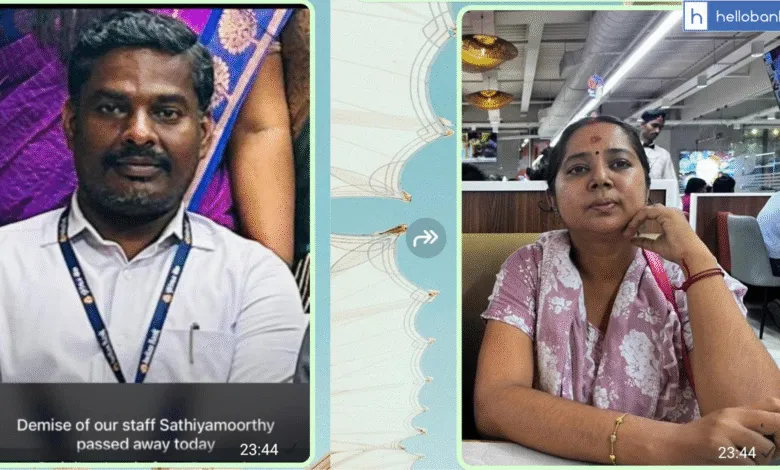
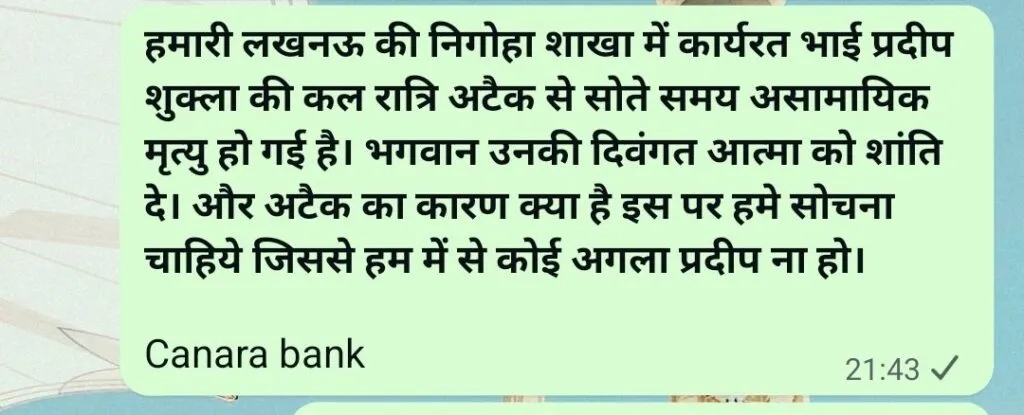
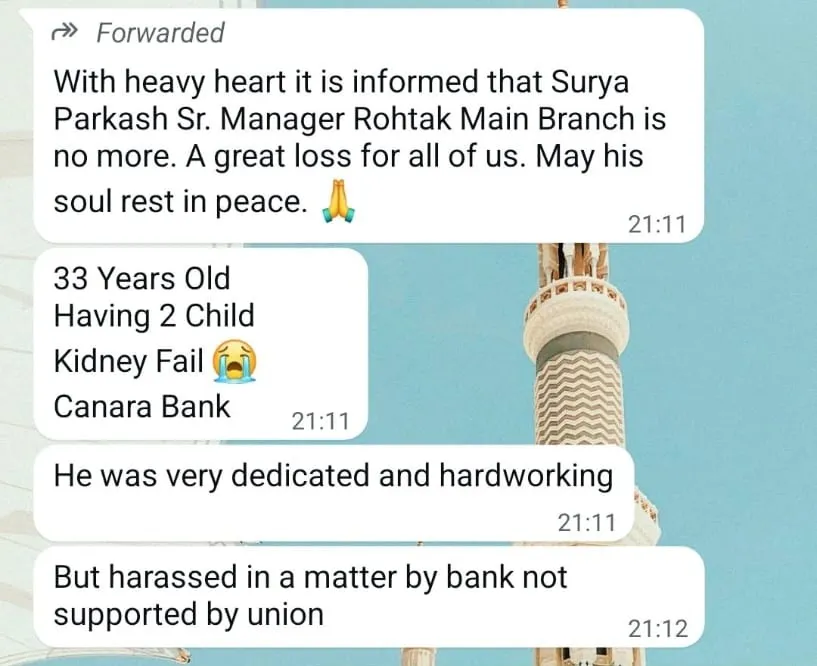
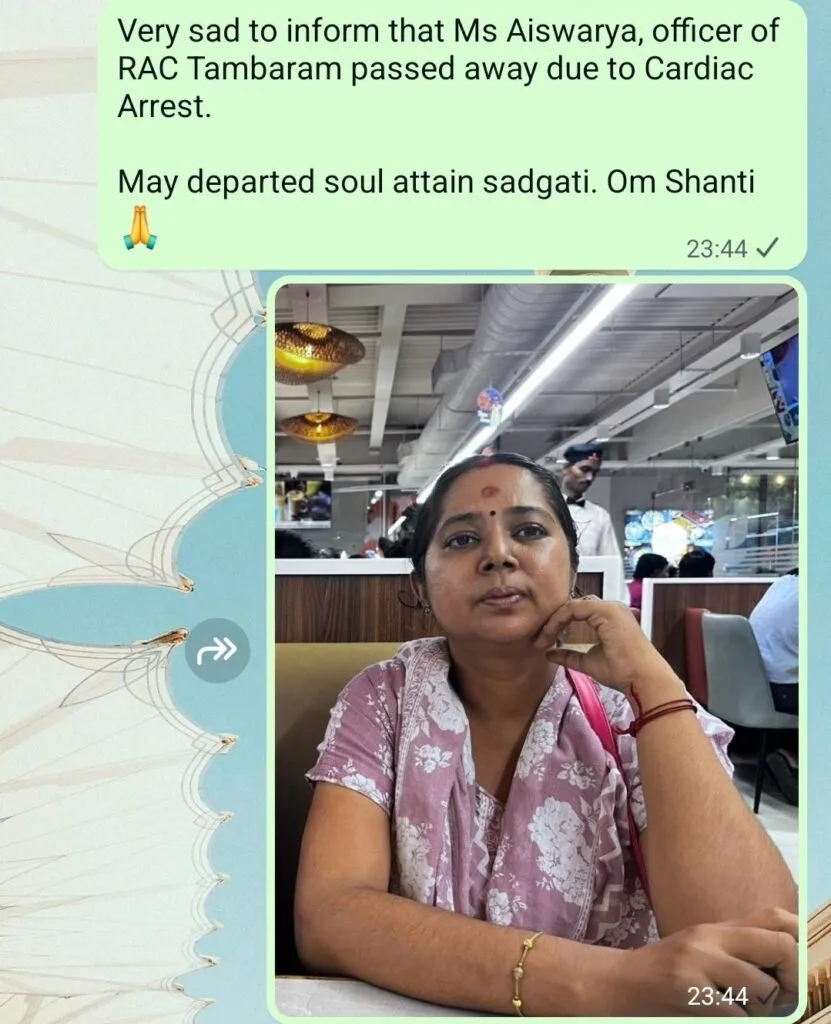
Recently, several deaths due to cardiac arrest have been reported in Public Sector Banks in India. Some of the details are as given below:

Why is this happening?

Bankers often spend 10–12 hours a day dealing with targets, deadlines, and customer demands. This creates mental strain, which gradually translates into physical health issues. Stress is one of the leading triggers of hypertension, diabetes, and heart ailments, eventually leading to cardiac arrest.

Most bankers spend their working hours glued to desks and computer screens, with little room for physical movement. The absence of exercise, combined with unhealthy eating habits, further increases the risk of obesity and cholesterol-related problems. This sedentary routine silently damages the heart.

Lack of Work-Life Balance

Frequent transfers, weekend work, and the inability to spend time with family add to the mental burden. Emotional stress combined with physical strain makes bankers more vulnerable to sudden heart failures.

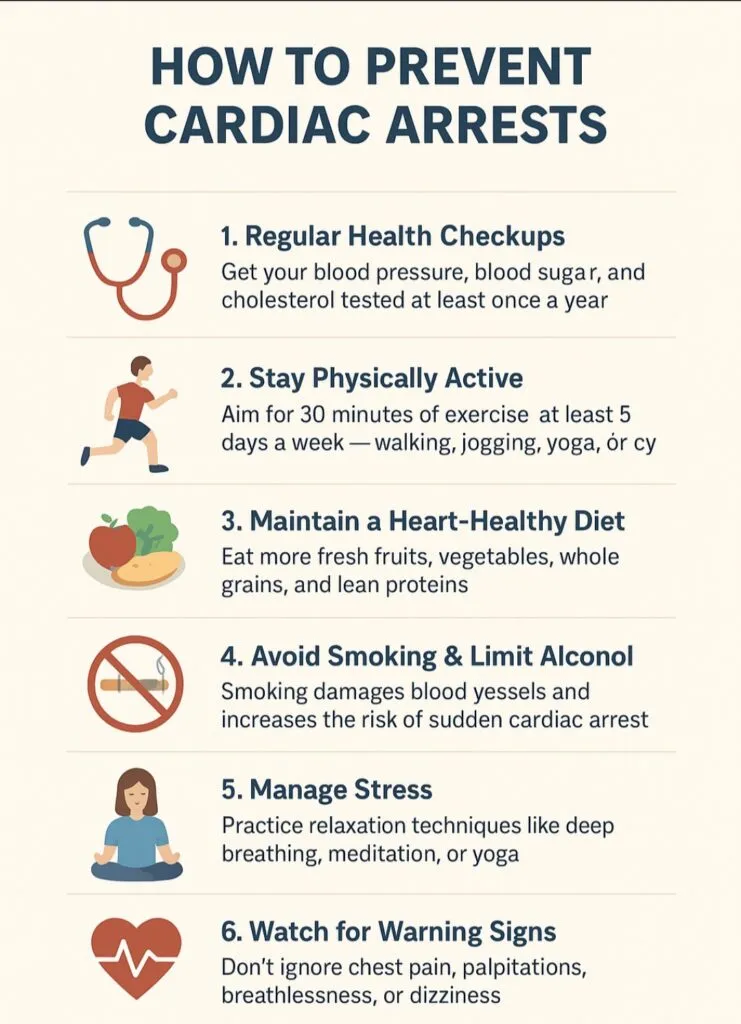
How to Prevent Cardiac Arrest


How to prevent cardiac arrest?

Sabbatical Leave Rules for Women Employees in Banks

The Government of India provides Sabbatical leave for women employees of Public Sector Banks to help them meet their special needs during th...

script async src="https://pagead2.googlesyndication.com/pagead/js/adsbygoogle.js">