BREAKING NEWS

BREAKING NEWS ""**Banks will remain closed from 2nd to 4th March 2026

VISITOR FROM WORLD

Free counters!

YOU ARE VISITOR

Blog Archive

LIVE

BREAKING NEWS ""**If we want PSU bank to compete with Pvt bank ---Give them a break Saturday first****Outcome of Today’s meeting with IBA - 31.01.2023*********

Wednesday, May 14, 2025

Employee Compulsorily Retired for Allegedly Mishebaving at Work, Court cancels order

The Patna High Court recently gave relief to a CISF constable, ruling that the punishment of compulsory retirement given to him for alleged misbehavior was too harsh and disproportionate. The court said this kind of punishment can violate the fundamental rights of a person and directed the concerned authorities to consider a less severe penalty.

What Happened?

Deo Narayan Singh, a constable at the CISF Unit in Dhanbad, was accused of misbehaving with a loading clerk named Sahdeo Thakur during duty hours. He was also accused of being absent from his post during a night shift and having a physical altercation with the clerk.

A charge sheet was issued against him under Rule 36 of the CISF Rules, and three charges were made:

  1. He was absent from duty for two hours on 29 July 2010.
  2. He left his post and got into a quarrel with the clerk around 1 AM.
  3. He had received 11 punishments earlier for various disciplinary violations, marking him as a habitual offender.

A departmental inquiry found him guilty, and as a result, he was given the punishment of compulsory retirement with full pension and gratuity. His appeals were rejected, and he eventually filed a writ petition in the High Court.

What Did the Constable Argue?

Narayan Singh, through his lawyer Bhairaw Sharma, said the punishment was too extreme for the charges. He also claimed that the inquiry process was unfair and went against the principles of natural justice. He said:

  • No proper chance was given to cross-examine witnesses.
  • There was no preliminary enquiry or show-cause notice.
  • The inquiry process was one-sided.

He also referred to a similar case (Union of India v. R.K. Sharma) where the court had struck down a similar harsh punishment.

What Did the Government Say?

The government’s lawyer argued that:

  • The constable had failed to get relief through appeal or revision.
  • There was no proof that the enquiry process was faulty.
  • The penalty was justified based on his behavior and record.

What Did the Court Decide?

The single-judge bench of Justice Purnendu Singh made the following observations:

  • There was no clear proof that Narayan Singh was given a fair chance to present his side.
  • While the charges were proved, the punishment of compulsory retirement was considered too harsh.
  • The court cited a Supreme Court ruling which said that even in cases of unauthorized absence, the employee should be treated as in service till they complete the required time for pension.

The judge also noted that:

  • An unfair or excessive punishment can violate Article 21 (Right to Life and Liberty) of the Constitution.
  • If the punishment is unreasonable, it also violates Article 14 (Right to Equality).

Final Decision

The court quashed the retirement order and sent the case back to the Disciplinary Authority, asking them to reconsider the punishment and impose a lesser penalty.

Why This Matters

This judgment is a reminder that disciplinary actions in government jobs must be fair and in line with constitutional rights. While misconduct must be addressed, the punishment should always be proportionate to the offense and carried out in a way that respects the principles of natural justice.

Saturday, May 10, 2025

Big News for Startups! Now you can get Free Loans upto Rs.20 crore


There is a good news for startups in India. The Government of India has increased the limit of collateral-free startup loans to Rs.20 crore.

The Indian government has approved an updated Credit Guarantee Scheme for Startups (CGSS), which will now give startups even more support in getting loans. The most important change is that the maximum guarantee per borrower has been doubled from ₹10 crore to ₹20 crore.

This scheme is designed to help startups get loans without the need for collateral (security). Many startups struggle to get loans because they don’t have assets to offer as security. With this scheme, the government promises to cover part of the risk for banks, NBFCs, and financial institutions, making it easier for them to lend money to startups.

What is the purpose of the CGSS?

The main goal of the Credit Guarantee Scheme for Startups is to give startups access to loans and credit facilities without needing to pledge assets. The government steps in as a guarantor, covering a portion of the loan if the startup fails to repay. This makes banks and lenders feel safer and more willing to support early-stage companies.

Who can benefit from the scheme?

The scheme applies to startups that are eligible under the rules, and the lenders include banks, financial institutions (FIs), non-banking financial companies (NBFCs), and alternative investment funds (AIFs) that are part of the scheme.

What are the key updates?

Here’s a simple breakdown of the major updates:
✅ Maximum guarantee per borrower: Increased from ₹10 crore to ₹20 crore.
✅ Guarantee cover (amount the government promises to cover if the borrower defaults):

  • 85% for loans up to ₹10 crore
  • 75% for loans above ₹10 crore
    ✅ Annual Guarantee Fee (AGF): For startups in 27 key sectors called “champion sectors,” the fee has been reduced from 2% to 1% per year.

Why is this important?

Startups often need money to fund research, development, innovation, and new technologies. But lenders see startups as risky, so they hesitate to give loans. With this updated scheme, the government helps reduce the risk for lenders, which encourages them to provide more funding to young businesses. This also supports India’s goal of becoming a hub for innovation and entrepreneurship.

When does the new rule start?

The new notification replaces the earlier one from October 6, 2022, and comes into effect from May 8, 2025.

How does this fit into the bigger picture?

The change was first proposed in the Union Budget 2025–26 as part of efforts to boost startup funding in India. By giving startups easier access to loans, the government hopes to boost job creation, promote innovation, and strengthen India’s position as a global startup powerhouse.

How to apply for startup loan?

You can easily apply for startup loan by visiting any branch of your bank. Some Banks like SBI also provide opportunity to apply for startup loan online. 

Now You can pay LIC premium easily via WhatsApp, Know How

Making LIC payments has now become super easy. You can now pay LIC premiums easily via WhatsApp. LIC has launched a WhatsApp bot to make the payment system easy and smooth.

This new service, called “Premium Payment through WhatsApp Bot,” was officially introduced on May 9, 2025. The launch event was led by LIC’s CEO and Managing Director, Shri Siddhartha Mohanty. He was joined by other top LIC officials, including Managing Directors Shri M. Jagannath, Shri Tablesh Pandey, Shri Sat Pal Bhanoo, and Shri R. Doraiswamy.

Through this WhatsApp bot, LIC policyholders can check which policies need premium payment and can pay directly through UPI, net banking, or credit/debit cards.

How LIC users can do payment of premium?

LIC users need to save this mobile number 8976862090 to their contacts list. After saving the number, you need to send ‘Hi’ to this number.

LIC services available on WhatsApp:

  1. Premium due
  2. Bonus information
  3. Policy status
  4. Loan eligibility quotation
  5. Loan repayment quotation
  6. Loan interest due
  7. Premium paid certificate
  8. ULIP – Statement of units
  9. Pension [IPP] details
  10. Pension [IPP] credit details
  11. Claim due date
  12. Claim paid details
  13. LIC service links
  14. Opt In/Opt Out services
  15. End conversation

You just need to select serial number of service you want. For example: If you want to check policy status, then select 3. If you want to pay premium of policy then select 1.

LIC Whatsapp Services

LIC provides following services on whatsapp. You can use services without visiting LIC branch

Thursday, May 8, 2025

Rs.800 Crore GST Scam: ED Raids Jharkhand and West Bengal in Fake ITC Claim Fraud

Rs.800 Crore GST Scam: ED Raids Jharkhand and West Bengal in Fake ITC Claim Fraud


On Thursday, the Enforcement Directorate (ED) launched a major crackdown on a huge tax fraud case involving the Goods and Services Tax (GST). The ED raided nine different placesfour in Jharkhand (including three in the capital city Ranchi and one in Jamshedpur), and five in West Bengal—as part of their ongoing investigation.

What is the Case About?

This operation is part of a probe into a massive ₹800 crore scam. According to ED sources, the fraud involves fake claims of input tax credit (ITC). ITC is a benefit that businesses can claim to reduce the amount of tax they have to pay. In this scam, people allegedly created fake invoices (bills) to claim tax credit without actually doing any real business.

The total amount of fake invoices generated is said to be over ₹14,325 crore. These were reportedly made using shell companies—companies that exist only on paper and have no real operations. The people involved created fake documents, claimed the tax credit, and then shut down these fake companies to avoid being caught.

Who is Involved?

Some of the names under investigation include:

  • Shivkumar Deora
  • Sumit Gupta
  • Amit Gupta
  • And several others

During the raids, ED officials seized important documents, which they are now closely examining to gather more proof.

Security and Past Actions

To ensure the safety of the officers involved in the raids, the Central Reserve Police Force (CRPF) was deployed at all the locations. While the ED had previously conducted raids in West Bengal last year related to this case, this is the first major operation in Jharkhand.

Earlier Findings

This is not the first time authorities have uncovered such frauds:

  • Last year, the GST Directorate found a ₹100 crore fake invoice scam in Sarubdera (Ramgarh) and Jharia (Dhanbad).
  • Another ₹150 crore scam was found in Jamshedpur and Adityapur industrial areas.


What’s Next?

As of now, the ED has not made any official statement, since the investigation is still ongoing. Officials are expected to share more information once they complete reviewing the seized materials.

Wednesday, May 7, 2025

Are Banks Closed due to War Situation in India? Should You Withdraw Cash From Bank?

India has destroyed various terrorist camps in Pakistan and POK in Operation Sindoor. Now, there is war like situation between India and Pakistan. Amid this, the Government of India also conducted a nationwide civil defence mock drill on 7 May to aware citizens about the measures to be taken in war situations.

But you need not worry. The Government of India and the Indian Armed Forces are ready to tackle any enemy attack. Meanwhile, if you are worried about finances, then also you need not worry. The Government of India has asked all government banks in India to remain open and provide customer service amid this situation. You need not panic. All the PSU Banks will remain open and you can easily withdraw cash from bank. You need not rush to Banks to withdraw cash. 

All the Public Sector Banks in India – SBI, PNB, BOB, Canara Bank, Union Bank and all other banks are open and will remain open. The public sector banks in India have sent emails to their employees not to leave Headquarters and ensure seamless banking operations during these tough times.

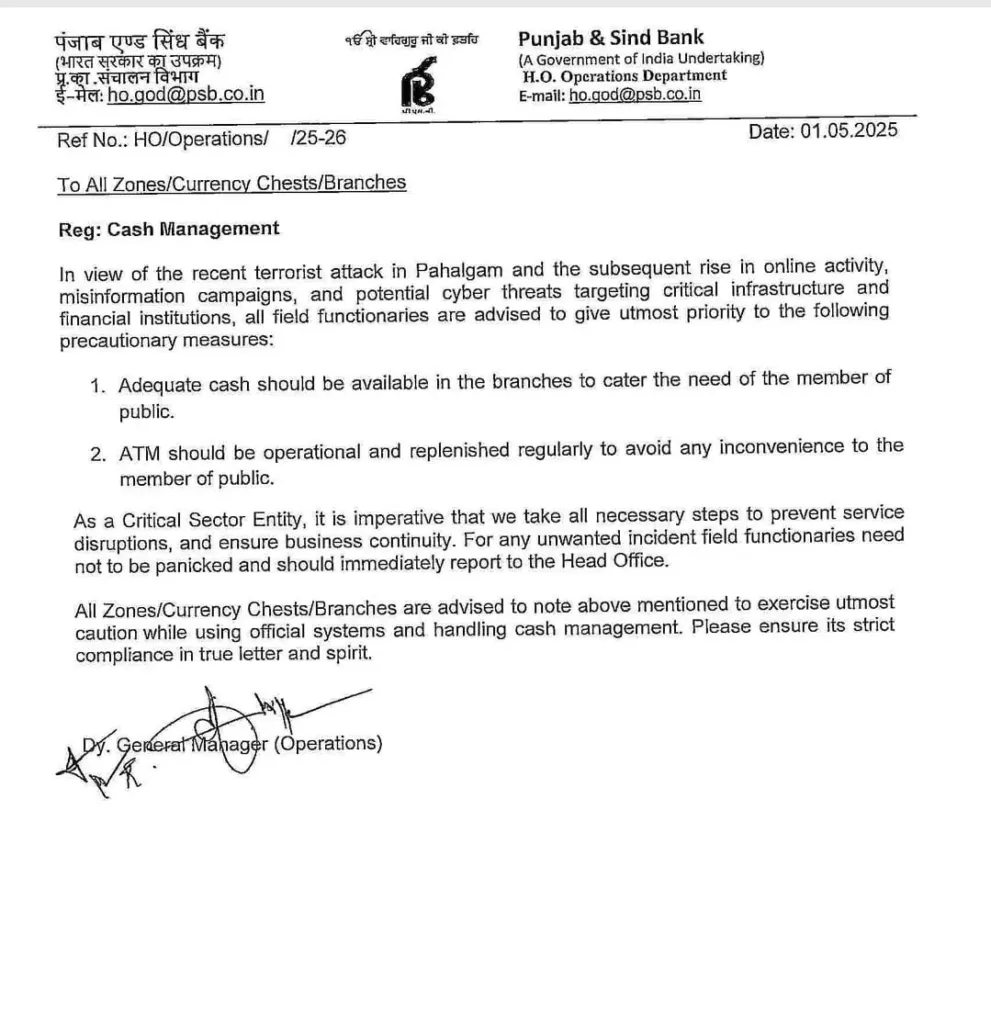
The emails from Canara Bank and Punjab & Sind Bank have gone viral on social media. As per email of Canara Bank, Employees have been asked not to leave Headquarters for the next two weeks. Regional Heads and Branch Heads have been advised to be present in their offices and branches and not leave Headquarters.

The email said that high alert has been declared in various parts of the country and in view of the present sensitive situation in the nation, it is instructed to take appropriate steps to ensure continuity in the Banking services. The email said that all Circle Heads shall ensure proper functioning of the branches to extend banking services seamlessly.

Apart from Canara Bank, Punjab & Sind Bank has also released an E-mail to its employees. The email said that in view of the recent terrorist attack in Pahalgam and the subsequent rise in online activity, misinformation, campaigns and potential cyber threats targeting critical infrastructure and financial institutions, all staff must ensure that adequate cash should be available in the branches to cater the need of the public.

The email directed the staff to ensure that ATM should be operational and replenished regularly to avoid any inconvenience to the public. The email urged the staff to take all appropriate steps to ensure seamless banking services to the public.

Banking is an important sector in India and PSU Banks are the backbone of Indian Economy. At the time of COVID-19 also, the bank staff worked hard to provide uninterrupted banking services to the public. When the entire nation was working from home, the government banks were open and employees were working. Even though, many of the bank employees succumbed to COVID-19, they continued providing banking services to the public. Today also, in this war like situation, Banks are open and providing service to citizens.


Expected DA for Bankers

script async src="https://pagead2.googlesyndication.com/pagead/js/adsbygoogle.js">